Showing posts with label Nepal. Show all posts

Thursday, September 1, 2016

Uterine Prolapse Prevention Program--Part 2


We are proud to present to you Part 2 of the report of our Uterine Prolapse Prevention Program.

If you missed Part 1, read it here:  http://scheermemorialhospital.blogspot.com/2016/08/uterine-prolapse-prevention-program.htm

You will find the introduction and reasoning for the program...
and this Thank You:
We want to thank the Finland Ministry of Foreign Affairs and Finland's Adventist Development and 
Relief Agency (ADRA) for the financial and emotional support they gave us to have the chance to give educational information to Nepal's next generation.  We also thank all those all over the world who also support us, not only financially, but also prayerfully!  Thank you!

Now, here is Part 2, quoted from the official report  written by Mr. Sundar Thapa,
Senior Executive Officer and director of the program.  The photos are also Mr. Thapa's.

"The second and final phase of training was conducted from 08 – 10 April 2015 by  Scheer Memorial Hospital OB/GYN, physiotherapy and nursing staff, Dr. Binod  Aryal, Dinesh Chataut, and Mrs. Sunita Chataut, respectively.


"Train-the-Trainer candidates learned about anatomic support structures for pelvic    organs, as well as how failure of these structures results in pelvic organ prolapse.  They also learned  simple steps could be taken to prevent this condition.  This was essential training for these trainers to be able to train other individuals in the causes  and prevention of pelvic organ prolapse.


"Because of the major earthquakes in Nepal on 25 April and 12 May, commencement of the rest of our program was delayed until late August. 

"The training of teachers sessions lasted for two days, whereas health teachers (who have a stronger background in health sciences) only required one day of training. The training centers were placed in appropriate secondary/higher secondary schools, i.e. those schools that have been used as a Resource Center and which covered at least 15-25 schools in that particular cluster.

  " A 20-minute video called 'Obstacles yet to Overcome' precedes the actual start of instruction. This emotionally-charged video affects most people who watch it and provides an understanding the plight of many women in Nepal.   It portrays the difficulties their medical condition imposes on them, their families, and the communities in which they live.  It highlights the many challenges of daily life and especially the social isolation from family and community that pelvic organ prolapse creates.


          "On the first day, only the Female Community Health Volunteers attended training.  On the second day the health teachers also attend, but all training was conducted separately.  Prior to the start of training, a short introduction was provided, followed by a pre-test to assess the student’s level of knowledge regarding pelvic organ prolapse. At the end of training, all students took a post-test to assess their level of comprehension and mastery of the material."


Mr. Sundar Thapa and Mr. Dhruwa Nepal pass out completion certificates in Banepa, 
Kavre District.


Bhupan gave lectures for health teachers.  This lecture was at Kawasoti Center,
Nawalparasi District. 

Training sessions commenced here and there:


Syangja:

Syangja:

Nawalparasi:
Ramechhap:
A district health officer from Ramechhap visited a training session.


We want to thank all of the team members for their time, efforts, and participation
in this important program.


Stay tuned for Part 3, which will show you the pictures of the program in progress at schools where young people were fortunate to learn about preventing this condition for themselves
and future generations.

Have a nice day and thank you again to all of our friends and supporters for all you do!

Monday, August 15, 2016

Uterine Prolapse Prevention Program--Part 1

We are proud to present to you Part 1 of the report of our Uterine Prolapse Prevention Program.

You may have heard that uterine prolapse is a huge health problem in Nepal.
http://america.aljazeera.com/articles/2014/6/9/uterine-prolapsethehiddenagonyofnepalesewomen.html

We are thankful for medical teams who give of their time and medical expertise, and using their own
financial support, come and do surgery for uterine prolapse victims, many of whom have
been acutely suffering in silence for many years.

To read more about their work, check out the websites of these teams:

Centura Global Health Initiatives:
https://www.centuraglobalhealth.org/CGH/Home/

Vrouwen voor Vrouwen...or Women for Women in English.
This organization is from Holland and their website is in Dutch.
Below is the translated link.  If you have trouble, use your own translator.
https://translate.google.com.np/translate?hl=en&sl=nl&u=http://www.vrouwenvoorvrouwen.nl/&prev=search

Open Heart International:
http://www.ohi.org.au/

If you missed it, see our June 6, 2016, post for a uterine prolapse patient story.

However, treatment is something done after the fact.  Prevention can open up the world
to upcoming generations of young Nepalese women who won't have to suffer as their
mothers, grandmothers, aunts, friends, etc. have done for countless years.

Prevention and educational programs are necessary for this reason.

Here is a long, but comprehensive study about prevention:
http://www.ncbi.nlm.nih.gov/pmc/articles/PMC3422110/

Knowing the necessity of joining the other organizations with prevention programs,
Scheer Memorial Hospital was able to launch its own Uterine Prolapse Prevention Program.

Here, in quotes, are details from the official report written by Mr. Sundar Thapa,
Senior Executive Officer and director of the program.

"As a country, Nepal faces many health challenges.  A major affliction affecting many women is the wide-spread problem of uterine or pelvic organ prolapse.  This disorder results from the heavy labor and the societal roles of Nepali women, in addition to the lack of proper nutrition.  Carrying heavy loads, returning to manual labor soon after child birth, home childbirth deliveries, and social taboos are also major contributing factors.

        "Non-governmental organizations (NGOs) and International NGOs (INGOs) traditionally concentrate their efforts on treatment programs rather than pursuing the more effective prevention programs.  In collaboration with the Finland Ministry of Foreign Affairs and Adventist Development and Relief Agency (ADRA) Finland, Scheer Memorial Hospital sought a different approach.  We initiated an educational project (Uterine Prolapse Prevention Program or UP3) to train Female Community Health Volunteers, with three-four volunteers chosen from each Village Development Committee and Health Teachers from each of the government run secondary/higher secondary schools within each district.

Dr. Dale Mole', Scheer Memorial Hospital's CEO, signs the agreement between
Scheer Memorial Hospital and ADRA Finland to implement the program.
(photo credit:  ADRA Finland)

(Note:  We want to thank the Finland Ministry of Foreign Affairs and Finland's Adventist Development and Relief Agency (ADRA) for the financial and emotional support they gave us to have the chance to give educational information to Nepal's next generation.  We also thank all those all over the world who also support us, not only financially, but also prayerfully!  Thank you!)

         "Prior to conducting training sessions for Female Community Health Volunteers and Health Teachers, an orientation program was conducted for district officials such as the Chief District Officer, Local Development Officer, District Health Officer, and District Education Officer.  Other concerned officials, as well as local media, also attend the orientation and education programs which provided a broad overview of the project and its objectives. 


"The Training for Fieldwork Trainers or Training of Trainers was conducted for our selected candidates by a team of experts provided by Mrs. Aune Greggas (Finland).  A large Finnish contingent was augmented by local experts at Scheer Memorial Hospital.  

Some of the participants:
(photo credit:  ADRA Finland)

"The first phase of intensive training was conducted from 18 – 20 March 2015 at SMH.  The team consisted of the following experts:

·         ""Mrs. Ritva Kuusisto – Midwife & Public Health Nurse and Trainer: She provided instruction on the uterus from conception to delivery, physiologic changes that occur with pregnancy, and what steps are important for a healthy mother and baby.  

·         "Mrs. Harriet Fagerholm – Physiotherapist: With the assistance of her son, Andreas Fagerholm as a translator, explained the importance of Kegel's exercise in strengthening the pelvic floor muscles and its role in the prevention of pelvic organ prolapse.

·         "Mr. Ben Greggas – Program strategist: Provided an overview of the benefits, including the economic advantages, of preventing pelvic organ prolapse.  He provide a comprehensive overview of often ignored or rarely considered aspects of the benefits derived from prevention programs.

·         "Mrs. Uma Thapa, Director of Nursing at SMH - Mrs. Aune Greggas had asked her to present in Nepali all the most important topics from her health education workbook "Healthy and Happy Nepal". The workbook and the PowerPoint-lectures have been translated into Nepali and they will help the participants to find good sources of materials for health education to live healthy.  

·         "An additional aspect of this training session was the inclusion of two nursing students from Diaconia University of Applies Sciences (Finland), Hanna Maasola and Reija Koivukangas, who were able to assist with the program evaluation and measures of success."


Here is the main team from Finland, left to right,
Mrs. Ritva Kuusisto, Harriet and Andreas Fagerholm, Aune and Ben Greggas
(photo credit:  ADRA Finland)

Again, we want to thank them for coming and for helping us get this program up and running!

Stay tuned for Part 2!

Blessings to all of our friends and supporters!


Monday, July 6, 2015

Earthquake--Part 13: The Walls Came Tumbling Down

Earthquake--Part 13
The Walls Came Tumbling Down

Here is our incinerator building.

Well, it WAS our incinerator building.

It sustained serious cracks during the earthquakes, and the continued aftershocks.
Do you realize that we have had 340 some aftershocks above 4 on the Richter scale
and 20,000 under 4!  You know that saying, "My head is spinning!"
Well, that is a real feeling!

When checked for cracks and worthiness after the quakes and aftershocks,
our incinerator building didn't pass muster.


Here's a closer look.  The cracks went all around the building.

Large cracks traversed the outside too.


A determination was made that the building could not be fixed
and must come down before anyone would be hurt.

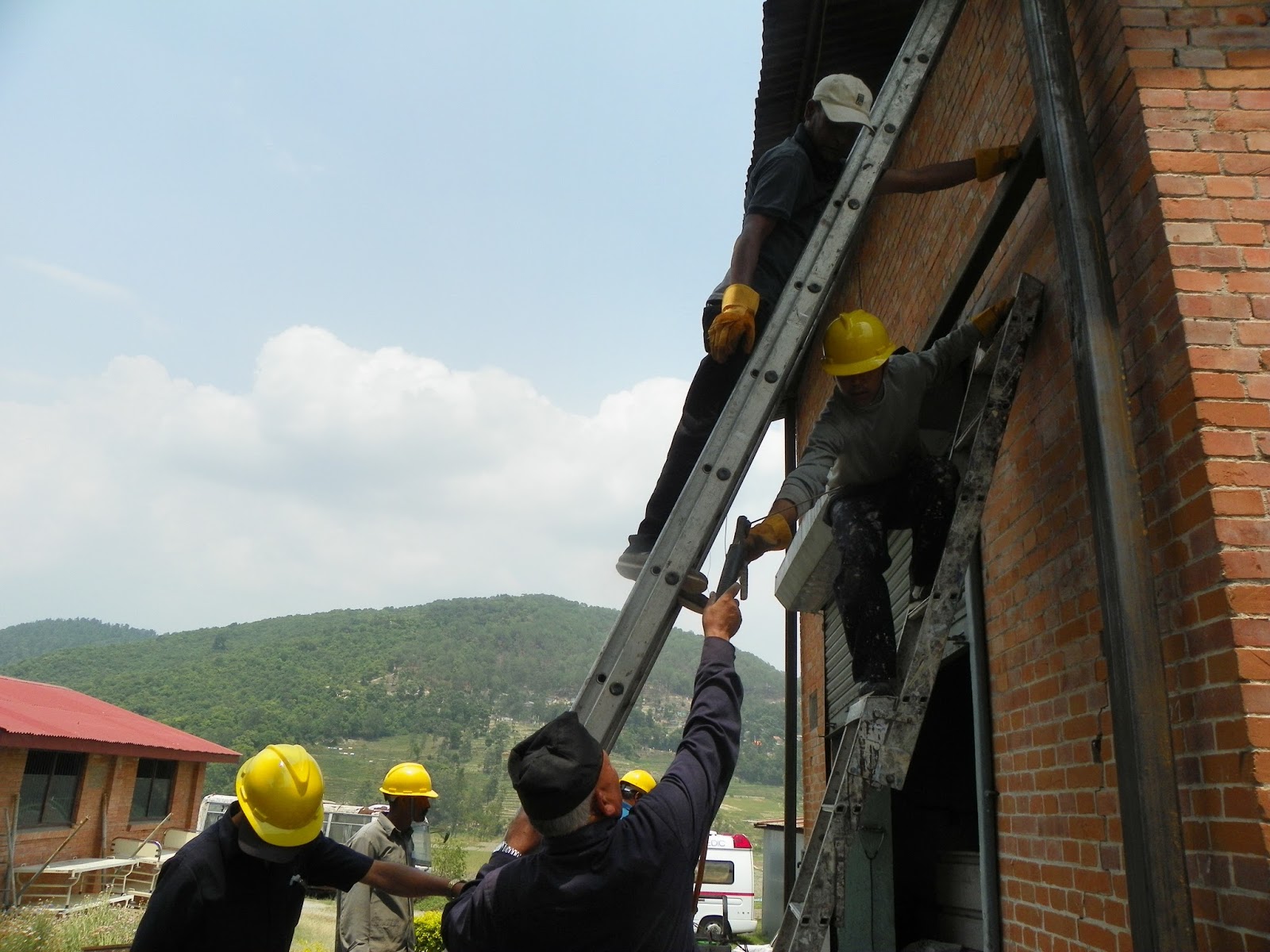
First a steel frame had to be built.

Our maintenance men stepped up to the task.

"Be careful!!!"

Another crew was called in to take down the bricks.

Then...the walls came tumbling down!


Then the walls were down.  No one was injured.  What a blessing!

We're very thankful that we will now be able to begin our reconstruction.
The bricks will be able to be recycled for a new building.

We want to take this moment to thank all of our friends and supporters who have been
able to send donations.  Your generosity is much needed and much appreciated!  All of you
will be in our thoughts and prayers as we are happy to know that we are in yours.

If you'd like to read the United Nations Nepal Information Platform Report on Nepal
Two Months On (from last week), it is here below.  You will note how vital assistance still is.
http://un.org.np/headlines/two-months-28-million-nepalese-still-require-vital-humanitarian-assistance

We will end with a few pictures of homes in the surrounding areas that still need to be
torn down and rebuilt.  With the rains hard and steady,


this is becoming more important every day.


The tents are current temporary housing.


Thanks again and have a blessed day!

Tuesday, May 26, 2015

Earthquake--Part 11: Visitors (Part 1)

Earthquake--Part 11:  Visitors

Visitors.

THANK YOU!!!

We have had some amazing visitors come to help out since that terrible day
which forever changed our lives one month ago.

We are happy and thankful for electricity, internet, food, and shelter.
Many do not have these yet and may not for some time.

The following Aljazeera article gives some insight about the situation here now,
plus has links to other interesting articles.

Our first visitors were Nepalese Army soldiers.
THANK YOU!!!!
They selflessly did whatever was needed during a time of sever aftershocks.
We were blessed with their presence and by their desire to help their fellow citizens.


Next we had visitors from India bearing gifts of apples, cookies, and water!
THANK YOU!
At that moment, these gifts really "hit the spot!"


Dr. Yuri Gelland, anesthesiologist from California, along with his son,
came to give medical care in health camp trips to devastated villages.
THANK YOU!!!  What a blessing they were to those they served.
Here, left to right, you see Dr. Dale Mole', Dr. Gelland's son, Dr. Gelland, and Bidur, our head driver.


Dr. David Kovar, cardiologist, from Colorado, came and spent his time giving medical care
with the organization Reach Nepal's food distribution teams.
THANK YOU!!!  You may never know who much hope you gave your patients!
(photo credits:  Reach Nepal)


A team from the Lions Club of Kavre Banepa


visited us and put up this sign:

Yes, there are sponsoring free food to our earthquake victim patients!
What a blessing!  THANK YOU!!!


SOS Children's Villages brought some babysitters and set up this tent.

THANK YOU!!!
Busy and sick parents could relax a little knowing their children had a safe place to play!
You can only imagine how useful this was!

These precious darlings can't really smile yet, but they can play!
Healing is starting!

Diego Laje from CNN Espanol, middle, seen here with Dr. Fernando Cardona, pediatrician, left,
and CEO Dr. Dale Mole', interviewed our doctors and presented a story for his listeners
of our earthquake experiences.  THANK YOU!!!
His story helped to bring awareness of our needs to the general public.

Visitors from Doctors Without Borders came to check out our blood supplies.
THANK YOU!!!  We so appreciated their help!
This is very important during "normal" times, and doubly so during a disaster.


This beautiful and sturdy ten, put up by our maintenance men (good job!),
was donated by International Medics, a Canadian group, courtesy of ADRA Nepal.
THANK YOU!!!  It has been so useful and beneficial, as you can imagine.


Here are the team members who brought it to us and assisted our maintenance men in raising it.
THANKS AGAIN!


Stay tuned for Part 2 of our Visitors post for information about the rest of our visitors.

In the meantime, we just want to say, "THANK YOU!" not only to everyone
who was able to come physically, but also for everyone who prayed,
and continues to pray, and also for those who are able to help with financial support.

THANK YOU!

The smile on this precious visitor says it all!

Until next time, blessings to all of you--and thanks again!